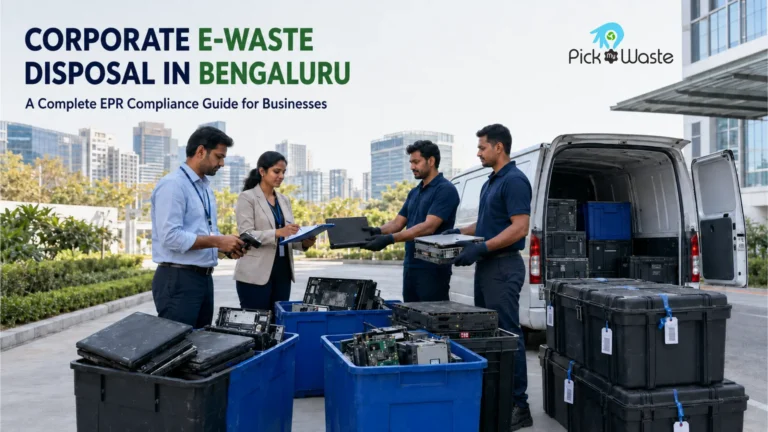
Corporate E-Waste Disposal in Bengaluru: A Complete EPR Compliance Guide for Businesses
August 22, 2026
Corporate e-waste disposal in Bengaluru with EPR compliance and secure data destruction.
Introduction
Bengaluru runs on electronics. From IT parks and data centres to startups, offices, and manufacturing facilities, organizations across the city regularly retire laptops, servers, monitors, networking equipment, and other electronic assets.
The real risk begins when these assets leave the organization without a verified collection process, secure data handling, or documented recycling pathway.
When an informal scrap dealer buys corporate e-waste or an unverified vendor receives it, the business may lose visibility over:
Where the equipment is transported?
Whether confidential data is securely destroyed?
Who dismantles or processes the equipment?
Whether the material reaches a registered recycler?
Whether valid disposal records can be produced during an audit?
For businesses, improper e-waste disposal is more than an environmental concern. It can create regulatory, financial, data-security, and reputational risks.
If you manage IT assets, facilities, procurement, administration, compliance, or sustainability for an organization in Bengaluru, this guide explains the applicable e-waste framework, the risks of improper disposal, and the steps required to build a more secure and traceable disposal program.
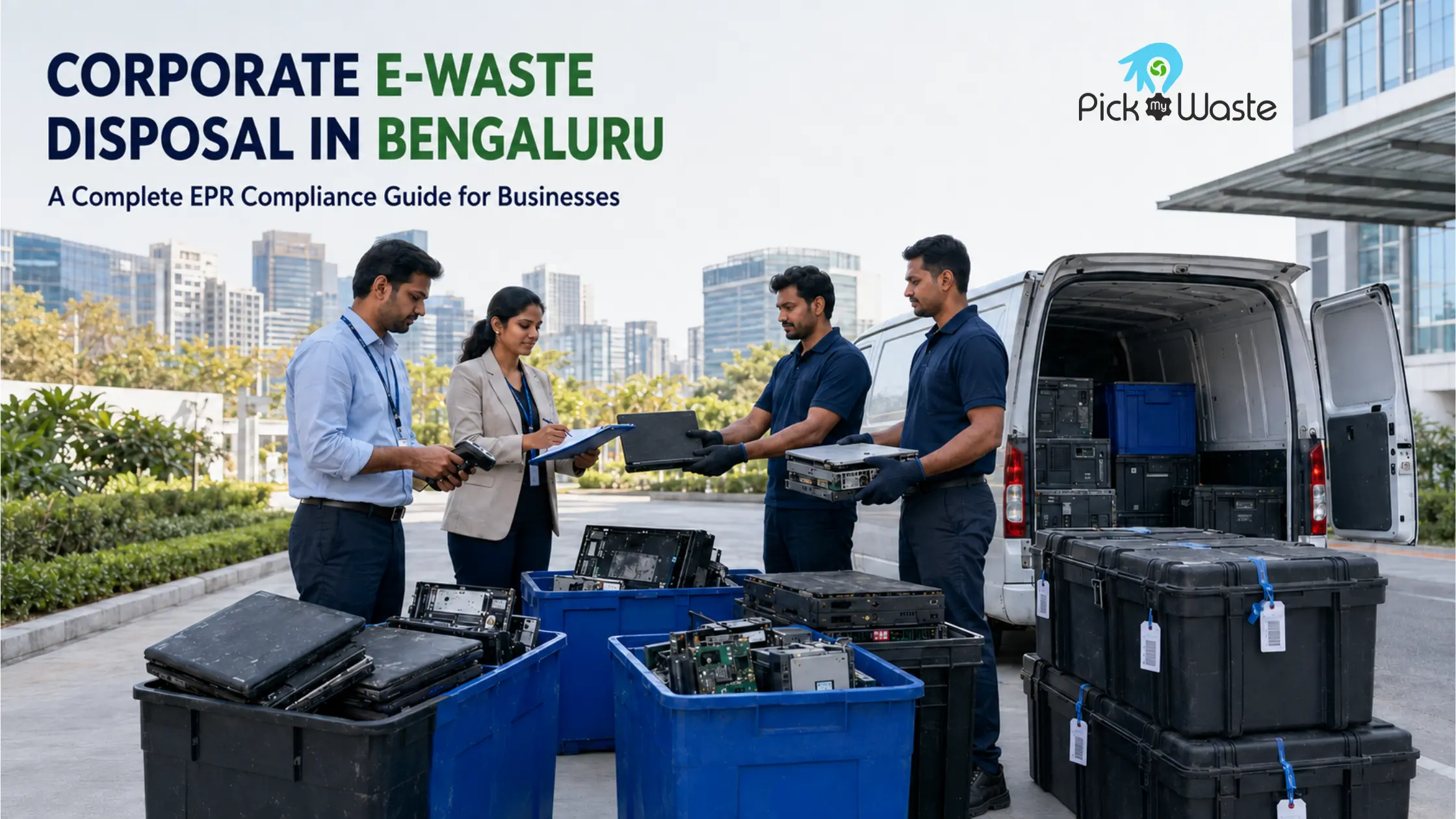
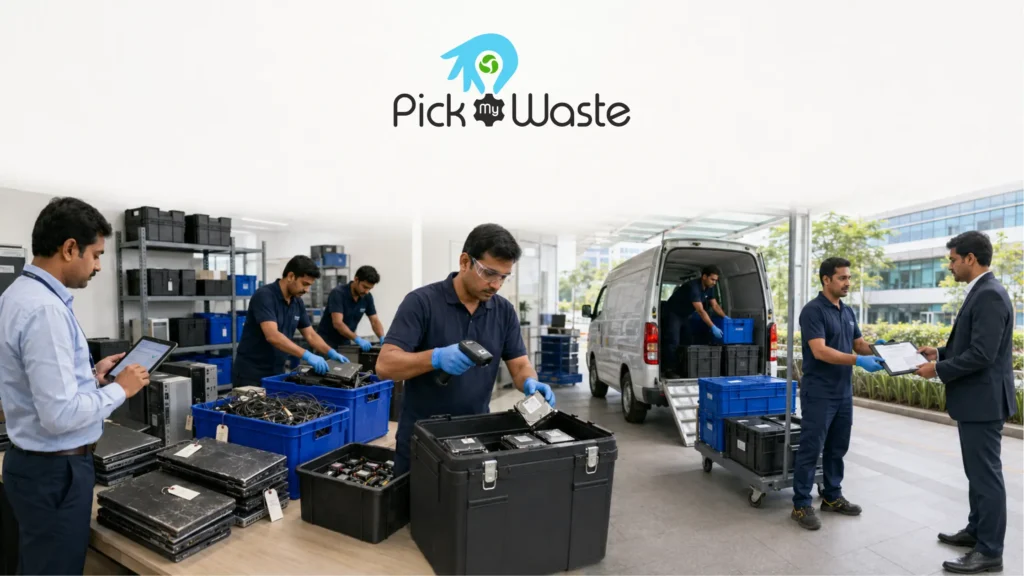
Hassle-free, on-site electronic waste pickup services customized for commercial and corporate campuses.
What Counts as Corporate E-Waste?
E-waste is not limited to visibly broken electronic devices. Under India’s e-waste framework, electrical and electronic equipment may become e-waste when it reaches the end of its useful life or is discarded, whether or not it is still functional.
Common categories of e-waste generated by Bengaluru businesses include:
Desktop computers, laptops, and servers
Monitors, keyboards, mouse and other peripherals
Routers, switches, and networking equipment
Company-issued mobile phones and tablets
Printers, scanners, and office electronics
Storage devices, including hard drives and solid-state drives
Cables, chargers, adapters, and power supplies
UPS equipment and related electrical components
Damaged or obsolete audio-visual and conferencing equipment
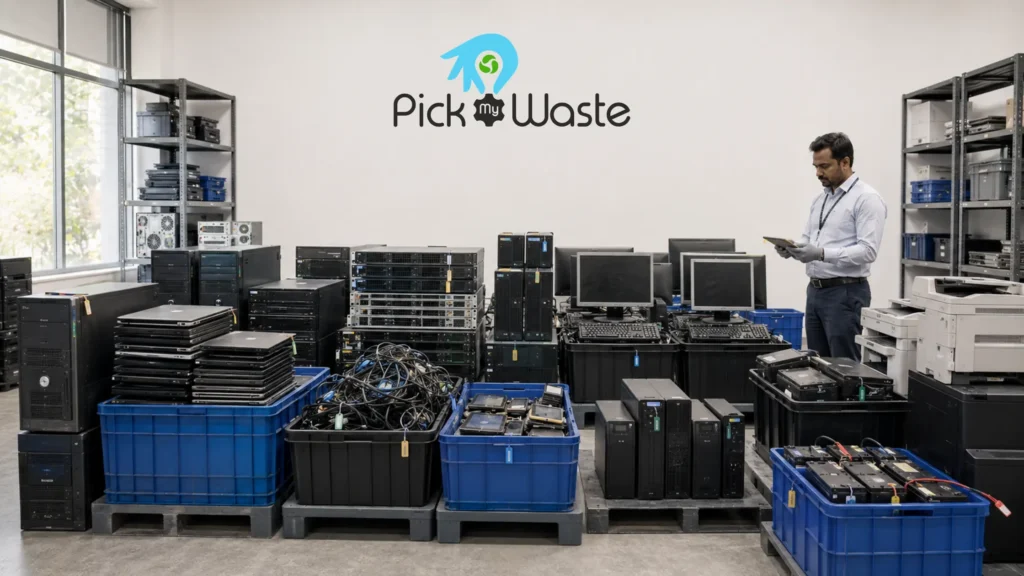
Scalable storage and processing solutions for bulk enterprise IT assets and electronic scrap.
A Note About Used Batteries
Waste batteries are governed separately under the Battery Waste Management Rules, 2022. They should therefore be separated from general e-waste and run through a proper, documented battery-waste channel.
Is Your Company a Bulk Consumer?
Under the current E-Waste (Management) Rules, a bulk consumer generally means an entity that has used at least 1,000 units of electrical and electronic equipment listed in Schedule I at any point during a particular financial year. The definition also includes e-retailers.
This means that not every small office automatically qualifies as a bulk consumer merely because it generates some electronic waste.
However, even organizations below this threshold should adopt responsible disposal practices because informal disposal can still expose them to the following:
Confidential-data leakage
Asset-control failures
Contractual and client due-diligence concerns
ESG reporting gaps
Reputational damage
Unsafe environmental outcomes
An organization that manufactures electronics, sells electronics under its own brand, or imports covered electronic equipment may also fall within the definitions of a manufacturer or producer, with separate registration and EPR obligations.
Understanding EPR and India’s E-Waste Rules
Corporate e-waste management in India is primarily governed by the E-Waste (Management) Rules, 2022, together with subsequent amendments.
The framework is administered by the Ministry of Environment, Forests, and Climate Change, while the Central Pollution Control Board operates the national E-Waste EPR Portal and registration system.
What Is Extended Producer Responsibility?
Extended Producer Responsibility, or EPR, places responsibility on producers of covered electrical and electronic equipment to meet prescribed recycling obligations through registered recyclers.
A business may qualify as a producer if it meets the following criteria:
Manufactures and sells covered electronic equipment under its own brand
Sells under its own brand equipment manufactured by another supplier
Imports covered electrical or electronic equipment
Imports used electrical or electronic equipment
A company that only uses electronic equipment in its office is not automatically a producer. Its responsibilities depend on whether it meets the legal definition of a bulk consumer or performs another regulated role.
Businesses should therefore distinguish between the following:
Producer EPR obligations, including registration and recycling targets; and
Responsible corporate disposal, including verified channelization, secure data destruction, and documentation.
A bulk consumer must ensure that covered e-waste is handed over only to a producer, refurbisher, or recycler registered on the CPCB E-Waste EPR Portal.
Businesses should not rely solely on a vendor’s verbal claim, website badge, or printed registration number. The registration should be independently verified before collection.
2. Maintain a Traceable Chain of Custody
The organization should know what happens to every asset from the moment it leaves the premises until it reaches its approved destination.
A suitable chain-of-custody process should record the following:
Asset description and quantity
Asset identification or serial number, where appropriate
Pickup date and location
Name of the collection organisation
Vehicle or transportation details
Receiving recycler or refurbisher
Final treatment or recycling status
3. Protect Data-Bearing Equipment
Laptops, servers, desktops, mobile phones, storage drives, and networking equipment may retain recoverable information even after files have been manually deleted.
Businesses should agree on the required data-destruction method before collection. Depending on the asset and sensitivity of the data, this may involve the following:
Secure data wiping
Cryptographic erasure
Degaussing, where technically appropriate
Physical destruction of storage media
Verification and documentation of the completed process
The selected method can be aligned with a recognized data-sanitization framework, such as NIST SP 800-88 Rev. 2, where appropriate.
4. Retain Disposal Documentation
Although the precise statutory documentation requirements depend on the organization’s legal role, keeping complete records is an important governance practice.
Recommended records include:
E-waste inventory
Pickup or collection acknowledgement
Asset handover record
Recycler registration details
Chain-of-custody documentation
Certificate of recycling or channelisation
Data-destruction certificate, where applicable
Weight summary
Environmental-impact report, where provided
These records can support internal audits, ESG disclosures, client assessments, and procurement due diligence.
Rigorous inventory checks and documentation ensure complete transparency for corporate e-waste compliance.
Why E-Waste Non-Compliance Is a Business Risk
Improper disposal is not a minor administrative gap. It can expose an organization to several interconnected risks.
Legal and Financial Risk
Failure to follow applicable e-waste requirements may lead to regulatory action, environmental compensation, or other consequences under environmental law, depending on the organization’s role and the nature of the violation.
Working with an unregistered or unverifiable vendor can also leave the company unable to demonstrate where its discarded assets ultimately went.
Data-Security Risk
A retired laptop, server, or hard drive may still contain:
Customer information
Employee records
Financial documents
Passwords and access credentials
Source code and intellectual property
Internal communications
Confidential client files
Deleting files or formatting a drive does not always make the underlying data irrecoverable. That is why secure, verifiable data destruction should form part of the IT asset disposition process.
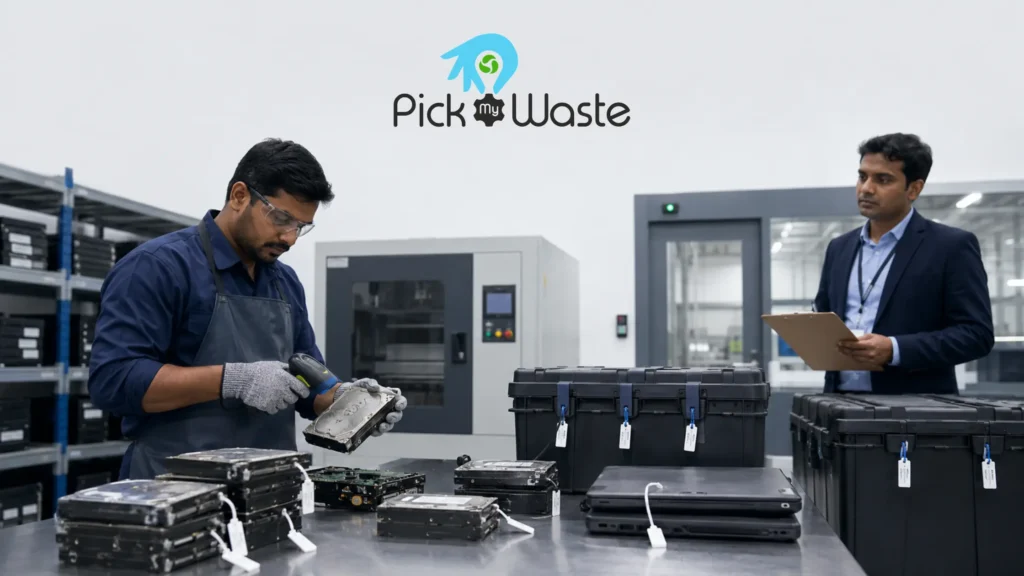
Guaranteed data privacy through precise serial tracking and certified data sanitization procedures.
Reputational and ESG Risk
Enterprise clients, investors, auditors, and government procurement teams increasingly examine vendor environmental and data-governance practices.
An organization that cannot produce disposal records, recycler details, or data-destruction evidence may appear unprepared during:
ESG assessments
Information-security audits
Vendor due diligence
Client onboarding
Government tenders
Sustainability reporting
Responsible e-waste management therefore supports both compliance readiness and corporate credibility.
How to Choose an E-Waste Recycler in Bengaluru
Not every vendor using the word “recycling” can provide a compliant and traceable service. Use the following checklist before approving an e-waste collection partner.
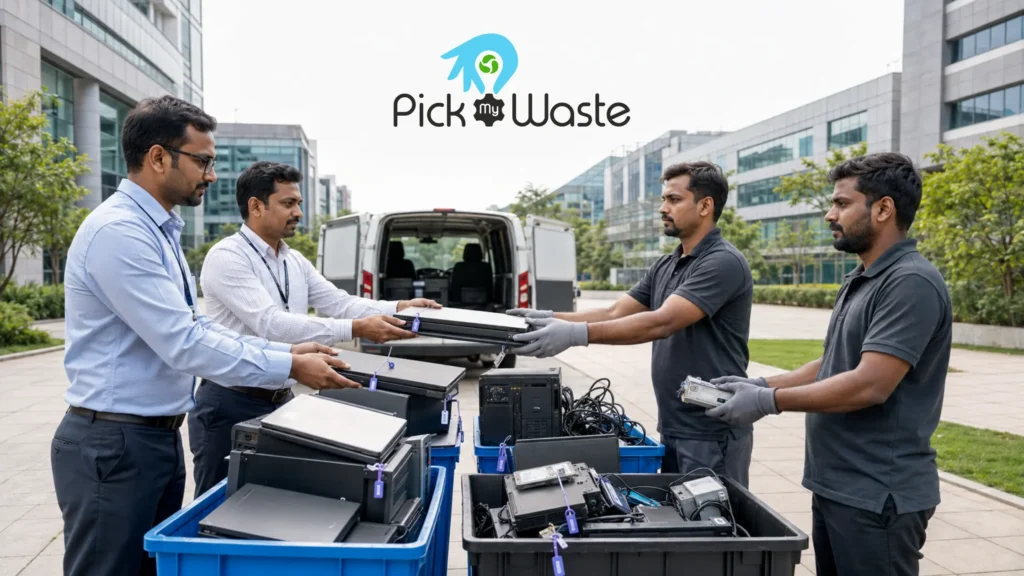
Streamlining corporate e-waste management with transparent auditing and certified recycling protocols.
Verify CPCB Registration
Ask for the recycler’s current registration details and verify them independently through the relevant CPCB system.
Do not rely only on a certificate image, a registration number printed on a brochure, or a verbal assurance.
Also confirm which registered recycler will receive the material if the pickup is conducted by a separate collection or logistics partner.
Review the Data-Destruction Process
For every data-bearing asset, confirm:
The destruction or sanitisation method
Whether the process is performed on-site or off-site
How assets remain secured during transportation
Whether destruction is recorded against individual assets or batches
A reliable partner should be able to explain the complete movement of the material—from pickup and transportation to processing and final channelization.
Look for:
Documented handover
Secure transportation
Tamper-evident storage where required
Asset-level or batch-level tracking
Recorded receipt at the processing facility
Clear identification of the final recycler
Check Corporate and Institutional Experience
A vendor experienced in corporate IT asset disposition will better understand:
Asset inventories
Data-security requirements
Multi-location pickups
Internal approvals
Audit documentation
ESG reporting
Certificates and reconciliation reports
Evaluate Bengaluru Collection Capability
Local collection capacity is important when disposing of equipment across offices, warehouses, institutions, or campuses.
A reliable Bengaluru collection partner should be able to provide:
Scheduled pickups
Secure handling of large asset volumes
Trained collection personnel
Suitable collection vehicles
Coordination with facilities and security teams
Documented channelisation to registered recyclers
Examine Environmental-Impact Reporting
Environmental-impact reporting can help translate the quantity of e-waste collected into understandable sustainability indicators.
However, businesses should ensure that any impact figures are:
Clearly labelled as measured or estimated
Based on disclosed assumptions
Not presented as government-certified unless independently verified
Separated from statutory recycling documentation
A Simple Corporate E-Waste Compliance Process
Step 1: Create an Asset Inventory
Maintain a current list of electronics approaching retirement across all departments.
The inventory should record:
Asset category
Quantity
Location
Working condition
Data-bearing status
Asset or serial number, where appropriate
Proposed disposal method
Step 2: Segregate E-Waste
Store retired electronics separately from general office waste.
Use clearly identified and secure storage areas for:
Data-bearing devices
Batteries
Broken screens
Cables and peripherals
Reusable equipment
Equipment awaiting recycling
This reduces accidental disposal and prevents individual departments from selling assets through informal channels.
Step 3: Verify the Receiving Entity
Before scheduling collection, confirm that the e-waste will be handed to an entity permitted under the current rules.
Verify:
Registration status
Facility details
Scope of services
Final recycling pathway
Data-destruction capability
Documentation to be issued
Step 4: Secure the Data
Decide the data-destruction method before the assets leave your organization.
The IT or information-security team should confirm:
Which assets contain sensitive data
Whether wiping or physical destruction is required
Who will witness or verify the process
What evidence must be retained
Whether the destruction results match the original inventory
Step 5: Arrange Documented Collection
At the time of pickup:
Count and reconcile the assets
Record the weight
Obtain a signed handover acknowledgement
Photograph the sealed collection where appropriate
Record the collection vehicle and personnel
Retain a copy of the inventory shared with the vendor
End-to-end electronic waste logistics ensuring secure chain-of-custody from office collection to processing.
Step 6: Collect and Reconcile Documentation
After processing, match the documents received against the original handover records.
Retain the following in one central compliance folder:
Collection acknowledgement
Final weight record
Recycling or channelisation certificate
Data-destruction certificate
Asset reconciliation report
Recycler registration evidence
Environmental-impact summary, where provided
Step 7: Make E-Waste Management Recurring
Businesses that treat e-waste disposal as an ongoing governance process are less likely to face last-minute problems during audits or client assessments.
Depending on asset-refresh cycles, organizations may schedule:
Quarterly collections
Half-yearly collections
Annual collections
Collections triggered by asset-refresh projects
The appropriate frequency depends on volume, available storage, data sensitivity, and internal controls.
Corporate E-Waste Compliance Checklist
Before closing an e-waste disposal project, confirm that:
All retired assets have been inventoried
Data-bearing equipment has been identified
Batteries have been segregated
The receiving entity’s registration has been verified
The final recycling destination is known
The data-destruction method has been approved
The handover has been documented
Asset quantities have been reconciled
Recycling and destruction documents have been received
Records have been stored for future audits
Frequently Asked Questions
Does My Company Have to Use a Registered E-Waste Recycler?
If your organization qualifies as a bulk consumer under the E-Waste (Management) Rules, covered e-waste must be handed over only to a registered producer, refurbisher, or recycler.
Even when an office does not meet the bulk-consumer threshold, using a traceable, registered recycling pathway remains a responsible risk-management practice.
Is Every Company Automatically a Bulk Consumer?
No. Under the current definition, a bulk consumer generally means an entity that has used at least 1,000 units of covered electrical and electronic equipment during a financial year, including an e-retailer.
An organization may still have separate obligations if it manufactures, imports, or sells covered electronic equipment under its own brand.
Is EPR Registration Required for Every Business That Generates E-Waste?
No. EPR registration and recycling targets primarily apply to producers of covered electrical and electronic equipment.
A company that uses electronics only in its operations does not automatically become a producer. The obligations of such an entity depend on the activities it carries out and whether it is a bulk consumer or other regulated entity.
What Happens to Data on Old Laptops and Servers?
Discarded storage devices can retain recoverable data even after files are deleted or the device is formatted.
Businesses should arrange an approved sanitization or destruction process and obtain suitable evidence, such as an asset-level or batch-level data-destruction certificate.
Can We Receive Evidence of Compliant Disposal?
A professional service provider should be able to provide appropriate records such as the following:
Collection acknowledgement
Asset handover report
Weight summary
Recycler or channelisation details
Recycling documentation
Data-destruction certificate, where included in the service
Ask what documents will be issued before approving the collection.
Do Small Offices Need a Responsible E-Waste Process?
A small office may not meet the legal definition of a bulk consumer. However, it should still avoid disposing of electronics through general waste or unverifiable informal channels.
Responsible collection protects the organization from data leakage, uncontrolled asset disposal, and reputational risk.
How Often Should Businesses Schedule E-Waste Collection?
The right frequency depends on the organization’s asset-refresh cycle, e-waste volume, storage capacity, and data-security controls.
Many mid-sized offices benefit from quarterly or half-yearly pickups, while smaller organizations may use an annual schedule. Collections should occur before storage becomes unsafe or assets are informally removed.
Should Batteries Be Included With Other E-Waste?
Waste batteries should be segregated because they are regulated under the Battery Waste Management Rules, 2022. Confirm that the service provider has an appropriate and documented channel for handling them.
Final Word
Corporate e-waste management in Bengaluru sits at the intersection of environmental responsibility, IT asset governance, data security, and vendor due diligence.
The safest approach is to treat electronic disposal as a controlled business process—not as a one-time office cleanup or informal scrap sale.
A defensible process should include:
Accurate asset inventory
Secure segregation and storage
Verified collection partners
Documented channelisation
Appropriate data destruction
Complete records for audits and ESG reporting
Organizations that establish this process early remain better prepared for client assessments, security audits, sustainability reporting, and future regulatory requirements.
Need Help With Corporate E-Waste Disposal in Bengaluru?
PickMyWaste supports businesses, institutions, and organizations in Bengaluru with:
Corporate e-waste collection
IT asset disposition support
Secure data-destruction workflows
Asset and collection documentation
Channelisation through registered recyclers
Environmental-impact reporting
Scheduled corporate e-waste pickups
Book a corporate e-waste pickup or ITAD consultation:
Disclaimer: This article provides general information and should not be treated as legal advice. Regulatory requirements may change. Verify the latest rules, amendments, registrations, and reporting requirements through the CPCB portal or a qualified compliance professional.